Explore Connect Discover
Langtang Valley Trek
A journey through alpine landscapes, Tamang heritage, and the quiet beauty of the Himalayas.
Overview
Langtang National Park is where Himalayan wilderness and living culture come together. Established in 1976 as Nepal's first Himalayan national park, it stretches from subtropical forests and lush valleys to alpine landscapes, glaciers, and towering peaks of the Langtang Himal. Along the trail, the landscape gradually unfolds. From dense forests and rushing rivers to traditional mountain villages shaped by Tamang culture and Buddhist heritage.
The Langtang Valley offers more than spectacular scenery. The journey leads through communities where traditional ways of life remain closely connected to the mountains, eventually reaching Kyanjin Gompa, surrounded by dramatic peaks, glaciers, and high-altitude landscapes. Along the way, there are moments to pause, explore viewpoints, cross rivers, encounter local communities, and simply take in the changing character of the Himalayas.
More than a trek, Langtang is a journey into the relationship between people, place, and nature, where every trail reveals a different layer of the Himalayan landscape and every village adds a story to the journey.
Highlights
Langtang "Yak and Cheese
Trail"
In Tibetan, 'Lang' means 'yak,' and 'tang' (or 'teng') means 'follow'/'trail,' meaning the name is associated with the ancient practice of transhumance, taking animals to different pastureland for grazing at different seasons. Inhabited by the Sherpa and Tamang communities, different villages are named after different actions taken by the Yak. Traditional butter production and its transportation to Tibet remain at the heart of the local economy.
In 1976, to protect the unique
culture and nature, the government of Nepal established Langtang as the first
Himalayan National Park in Nepal. Langtang Valley is green, full of beautiful
flora and small communities scattered along the valley walls. More than
60 species of mammals reside at Langtang, including a few: clouded leopard, snow leopard, red panda, Himalayan bear, langur, musk deer, red monkey,
Himalayan tahr, ghoral, Assamese monkey, grey wolf, leopard cat, and Tibetan
sheep. The park is also home to more than 250 species of birds. The Himalayan
Monal (national bird of Nepal), Satyr Tragopan, Ibisbill, Wood Snow Partridge,
Tibetan Snowcock, Himalayan Snowcock, Tibetan Partridge, Oriental Honey
Buzzard, Himalayan Griffin, Eurasian Griffin, Bar-headed Goose, Red-headed
Vulture, Cinereous Vulture, Yellow-rumped Honeyguide, Common Teal, and Tufted
Duck are some of the major attractive birds found in the park.
Chirping birds, hanging red monkeys, running musk deer, rare shy red pandas in lush green bamboo, and blue sheep strolling alpine meadows and mind-refreshing rhododendron forests refresh every traveler.
Himalayan Nature & Wildlife
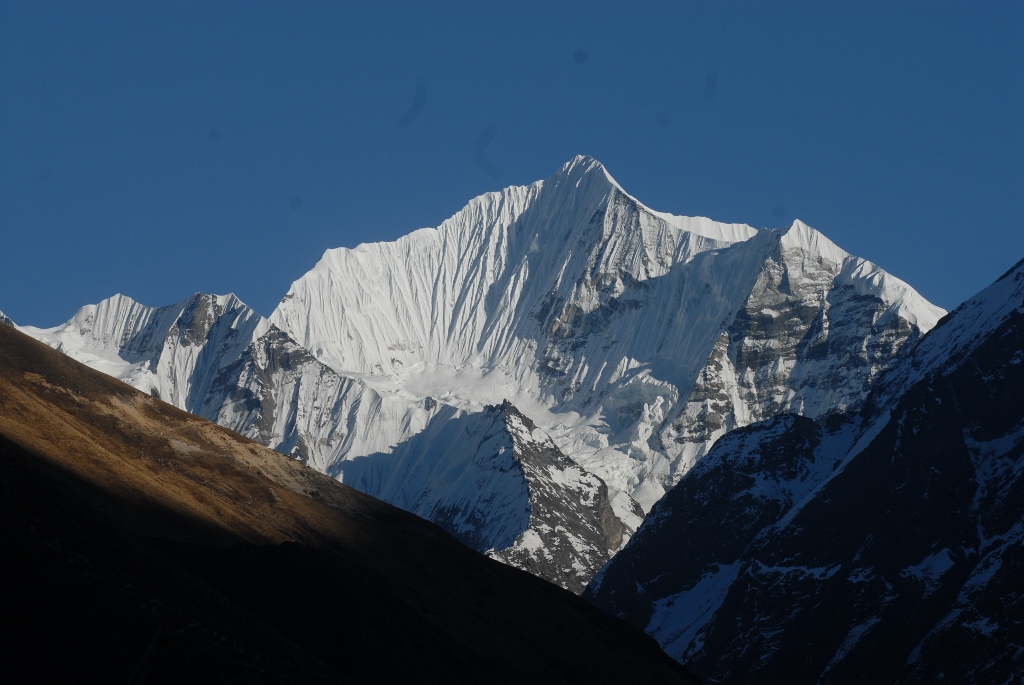
Langtang Lirung (7234M) is the
highest peak; Ghengu Liru (Langtang II, 6571M), Dorje Lakpa (6980M), Gangchempo
(6387M), Naya-Kanga (5846M), and Jugal Himal (6080M) are major mountains in Langtang
National Park of Narayani River and River Trisuli. A major
tributary of the Koshi River system, River Sunkoshi originates in the eastern
part of Langtang from the glacier of Langtang.
In the Langtang Valley trek, we
reach right next to Langtang Lirung (the highest peak in the Langtang
region) and see 360 views of the mountains and glaciers from different
viewpoint tops (RI) in Kangin Gumba. We can also hike near to glacier as
well.
Culture: 'BonPo,' 'Tamang Heritage'
Langtang is known as one of the 7
sacred valleys created by Guru Padmasambhava as a safe place from war, famine,
and natural disasters and a place for meditation and knowledge.
Langtang is an open museum to
understand culture with nature, Bonpo religion, and Tamang
culture. Inhabitants of the Langtang Valley are thought to be descendants
of Tibetans from Kerung who mingled with Tamang from the Helambu
region. Bonpo is an ancient Tibetan culture before the introduction of Buddhism. As
a shamanistic religion, it is characterized by mystic rituals, spells,
sacrifices for gods and spirits, and spirit manipulation. This religion
places much emphasis on meditative practice. The current traditions
of Buddhism, such as prayer wheels, sky burials, prayer flags, spirit traps,
festival dances, and rubbing holy stones, have all come from the Bon religion.
Tamang are one of the largest ethnic
groups in Nepal. Tamang culture and customs are widely seen in the Langtang
region. It is believed that "TAMANG" is said to be a Tibetan word
meaning horse traders. TA' means "horse," and 'MAN' means
"trader." They have their distinct culture, language, and
religion. They are traditionally Buddhist by religion, with close
relations with Hindu culture and customs from the lower land. Singing and
dancing in Damphu (traditional musical instruments) in Tamang Selo (melody) is
one major attraction.
The Trail Experience
The best part of the Langtang trail is a
very easy and moderate walk with a beautiful view at every step as you move forward. The flowing and refreshing sound of the Langtang River adds charm to
the journey. From Syprubesi, we walk through Dovan, then to Bamboo to cross
over to Lama Hotel. From here, our journey moves towards Langtang Valley, a
narrow river corridor valley with a front view of Mt. Langtang Lirung. As
we move forward to the highest point of the trek at Kanchen Gumba, a holy, spiritual, and ancient Buddhist valley at 3800 m, it's one of the seven sacred
valleys that is believed to be meditated on by Guru Padmasambhava. Visiting
Kanchen Gumba to see monks performing their rituals is a surreal experience. Besides being a spiritual Buddhist paradise, Kanchen Gumba is the hidden beauty of
nature; every corner is full of interesting places. Visiting glaciers, walking
towards Langsila (holy place), exploring the river, and hiking to Kanchen Ri (top) at 4950 m and Charku Ri at 5000 m for a 360-degree view of surrounding mountains, river
valley, hills, and glaciers are some of the best ways to explore and see beautiful
Langtang. Kanchen Gumba is also the starting point of the 2 most technically
difficult passes in the world—Tillman Pass and Ganja La.
Itinerary
-
Day 01: Arrival
Arrival
Day 1: Arrival in Kathmandu
On arrival, you will be greeted and transferred to the hotel in
Kathmandu. Briefing about Kathmandu City, climate, and the pre-trip meeting.
Afternoon or evening for independent activities, overnight at the hotel
Day 2: Preparation for trekking and Kathmandu sightseeing
Visits in Kathmandu: Swayambhu Stupa (a World Heritage Site), also
known as The Monkey Temple, with its 2500 years of history. Later, visit
Kathmandu Durbar Square (WHS), where you can see the Newa culture and
architecture, Hanuman Dhoka, Taleju Temple, the ancient royal residence,
Kasthamandap, and the Living Goddess Kumari Temple.
Finally, visit Patan Durbar Square (WHS), known as Lalitpur,
meaning The City of Fine Art. The square is famous for its fine examples of
wood and stone carving temples, including masterful wood-carved windows and
doors, the Taleju Temple, the Royal Bath, and the Krishna Temple. Overnight at
the hotel.
Day 3: Drive: Kathmandu to Syabrubesi
Today, after breakfast, we will drive
from Kathmandu Valley to Syabrubesi to begin our trek. Syabrubesi is about 120
kilometres away from Kathmandu. We expect to reach Syabrubesi in roughly 6-7
hours. The route to Syabrubesi is lush with greenery and hills, featuring ups
and downs, waterfalls, scenic valleys, and mountain views. The local shops,
residents going about their daily chores, terrace farms, wandering animals, and
the sound of rivers add charm to our journey. Along the way, we will stop for
lunch and refreshments.
At Syabrubesi, after checking into the
hotel, we will explore the area to learn more about the indigenous Tamang
community and their way of life. We will share our experiences and gain further
insight into Langtang Valley, its culture, and its natural beauty from our host.
Day 4: Syabrubesi to Lama Hotel
Today is an exciting day. After crossing the Bhote Koshi River,
we enter the Langtang Valley trail beside Langtang Khola. We walk together
through the forest, accompanied by the sounds of birds, rustling leaves and
bushes, and the Langtang River. At Dowan (the confluence of two rivers), we
will stop for tea, rest, and enjoy a small waterfall. After beginning a gentle
ascent to the top of the hill, we are treated to a stunning view of the
surrounding area. Following a short climb, the trail becomes easier, allowing
time to reflect on the beauty of nature, our pursuit of knowledge, and life
away from a busy schedule. We will stop for lunch at Bamboo. While our meal is
being prepared, we will enjoy moments by the riverside and explore local
handicrafts and daily life. The bamboo area is a prime habitat for red pandas.
After lunch, we will cross the suspension bridge and ascend to Rimche. From
Rimche, the descent will lead us to the Lama Hotel. At the Lama Hotel, after
some rest, we will take a walk in nature, visit the riverside, and learn about
the lifestyle of the local people.
Day 5: Lama Hotel to Langtang
Another day, another adventure. After breakfast, we will cross
over to the other side of the hill to reach the riverside. The forest trail is
easy, which gives us time to understand the changing geography, tree patterns,
birds, and surroundings. The landscape slowly changes to a mountain ecosystem.
At one point on this trail, we suddenly see Langtang Lirung framed in tree
branches.
At Riverside, the narrow valley begins to open up into more
expansive mountain landscapes. This area is celebrated for its diverse
wildlife. From the riverside, the trail ascends to reach Godha Tabela (Horse
Castle). From Godha Tabela, we will gain perspectives on Langtang Valley, the
mountains, waterfalls, and the fir forest. Godha Tabela also marks the starting
point of the mountain landscape, where you can see the different trails we
walked a couple of hours ago.
We will pass through a few small villages along the way, such as
Thyangsep, and eventually reach Langtang Valley. An important note is that the
Langtang Valley we visit now is the new one, relocated after the 2015
earthquake destroyed the old valley, resulting in the loss of lives and
infrastructure. On the way to the new Langtang Valley, you will walk along the
trail where the old valley once was. Once you arrive at Langtang Valley, you
can enjoy your free time experiencing local Tamang culture.
Day 6: Langtang to Kyanjin Gumba
Today we will begin our journey to Kyanjin Gumba. The walk to
Kyanjin is the shortest of the three days. As we trek towards Mundu, you
will be surrounded by tall mountain peaks. We will reach Kyanjin Gumba just in
time for lunch. We will explore the historic Kyanjin area.
While walking, we will pass many Chortens and stupas built and
dedicated to loved ones. The mantras carved in stone blend well with the
panoramic surroundings. The mantras are for a safe life from natural calamities
and a sound and healthy life. As the evening approaches, the weather turns cold
and windy, making it a perfect time to stay indoors and enjoy the view from
your hotel with a cup of coffee or tea.
Day 7: Kyanjin Gumba (day hike to Kyanjin RI)
In the morning, we will climb Kyanjin RI. At 4750 m above sea
level, we will stand tall next to Langtang Lirung and witness the mountain
environment.
In the afternoon, when I have free time, we will explore
the culture and history of the Kyanjin area and Tibetan Buddhism. We will also
visit the cheese factory and learn about the culture of Tran's humanism.
Day 8: Kyanjin Gumba to the Lama Hotel
On this day, we will leave Kyanjin Gumba and walk back to the
Lama Hotel. This time we have a different view with folding hills on the
horizon. More time to explore culture and nature
Day 9: Lama Hotel to Syabrubesi via Sherpa Gu
This is the final day of our trek, and we will use a different
route to reach Syabrubesi. From Rimche, instead of going downhill towards Bamboo,
we will take the upper route via Sherpa Gau. From the top, we could see the
other side of Langtang National Park, the flowing Langtang River, the trail we
had walked, and the places we had stopped for rest and lunch. Our trek ends at
Syabrubesi.
Day 10: Drive to Kathmandu
Early in the morning, we will drive back to Kathmandu.
Day 11: Onwards
We will transfer you to the
international airport for your departure.
Price
Price: To provide an accurate or approximate quotation, we need a few details about your trip, including the number of travelers, preferred accommodation category, mode of transportation (flight, bus, jeep, etc.), and any changes or customizations to the itinerary. Please share these details with us, and we will get back to you with a quotation.
Preparation
Guide: We will have a government-certified, well-trained guide for the whole duration of the journey.
Altitude Safety Profile:
Your safety is our
absolute priority. Trekking in the Himalayas involves ascending to high
elevations where oxygen levels drop significantly. Our itineraries are
strategically engineered by high-altitude specialists to encourage gradual
adaptation, keeping the risk of Acute Mountain Sickness (AMS) to an absolute
minimum.
Daily Health Screenings: Our lead guide carries a pulse oximeter to conduct mandatory
twice-daily checks of your blood oxygen saturation ($SpO_2$) and heart rate.
Hike High, Sleep Low: Our routes are physically structured to include daytime acclimatization walks to higher viewpoints, followed by sleeping at safer, lower elevations.
24/7 Helicopter
Evacuation: We maintain direct satellite/mobile communication links with
emergency dispatchers and helicopter rescue providers for immediate medical
evacuation if required.
Certified Wilderness Guides: All lead guides are fully certified in
Wilderness First Aid (WFA) and possess extensive training in identifying early,
subtle symptoms of AMS.
Emergency Medical Kits: Every group trek
carries a comprehensive first-aid kit containing essential high-altitude
medications (like Diamox) and portable medical oxygen cylinders.
Paced "Bistari" Ascent:
We enforce a strict, slow-paced walking rhythm to give your body ample time to
adjust to changing climate zones naturally.
Community & Sustainability
Local Livelihoods — Supporting local guides, accommodation providers, services, and community-based enterprises.
Learning from Communities — Creating meaningful connections with local people, knowledge, culture, and everyday life.
Giving Back — During and after our journeys, we support small community initiatives, including schools, health posts, and locally identified needs.
Caring for Place — Supporting small conservation initiatives and encouraging responsible stewardship of the natural and cultural landscapes we travel through.
FAQs
Frequently asked questions about route preparation, altitude, permits, and travel details.
How long is Langtang Valley trekking?
The standard Langtang Valley trek is 11 days including arrival and departure days. The trek can be completed in 8-9 days.
What is altitude sickness and its symptoms?
Generally, the first symptoms begin to show 12-24 hours after arriving at high altitudes. The different levels of altitude sickness have different symptoms. Symptoms of mild, short-term altitude sickness are dizziness, fatigue, loss of appetite, sleeping problems, general loss of energy, and shortness of breath. Sometimes, these symptoms may be accompanied by headache, nausea and vomiting.
How can we avoid Altitude sickness?
Our trek planning are done accordingly to adjust with altitude so that you dream trekking is done without any hassle.
Access to the internet and mobile charging ports during the trek?
Yes, almost all of the lodges throughout the Langtang Valley trek have Wi-Fi access and also charging ports for your easiness.
What sort of preparations shall I make for the Langtang Valley trek?
If you want to go do Langtang Valley trek, we recommend you to train physically and mentally. Also, outdoor exercises and activities like running, day hiking, cycling, etc. will help will ascending the trail.
Can I do the Langtang Valley trek on my own?
We do not recommend or suggest any travelers to go for the Langtang Valley trek alone. You must have an experienced guide for successful and efficient journey to the Langtang Valley. Recently Government of Nepal have made it mandatory to have guide/ porter guide during treks for safety and better enjoyment of journey.
Do I need any permits for Langtang Valley trek?
Yes, you will need to have a Langtang National park Permit) and TIMS (Trekker Information Management Service).
Best season for Langtang Valley trek?
The best time to trek Langtang Valley is from March to June and from October to December. The trekking season starts from mid-September after the end of Monsoon rain and in December the weather is usually stable with mild arm days and cold nights.
What kind of temperature and weather to expect in Langtang Valley trek?
The weather in the mountain region are changeable. This is why we need to prepare for change in weather, the twists, turns and volatility of the conditions that can occur in mountain region. We will provide you all details required for safe and comfortable journey.
Is Travel Insurance necessary for this trek?
Yes, travel insurance is mandatory because it will be useful in different situations throughout the trek.
Visa and Arrival
Can I get visa on arrival?
Yes, you can obtain a Nepal visa upon your arrival at the airport. There are kiosks in the arrival hall that you use to complete the necessary forms. The cost is USD 30 for a 15-day tourist visa, including numerous entries, or USD 50 and USD 125 for a 30-day or 90-day tourist visa including numerous entries respectively. You should carry cash (USD) with you to pay your visa fees quickly and easily, as digital payments are frequently unavailable.
To save time, we recommend filling out the online visa application form in advance. Applying online 2 weeks before your arrival will expedite the process at the airport.
Who will pick me at airport?
Our staff will be waiting for you outside the airport terminal with our signboard. You will be accompanied to a hotel in a private tourist vehicle.
Can I use debit/credit cards?
Yes in Kathmandu, Lukla and Namche. In other places it will be difficult. Please change/withdraw the currency before we go to the trekking.